Kuru Toga Pencils
The lead turns as you write
A Kuru Toga mechanical pencil turns its lead a fraction of a step every time the tip leaves the paper. Graphite wears around the point instead of flattening on one side, so the line stays close to the width it started at and small letters stay readable down the page. Mitsubishi Pencil has sold more than 100 million of them since 2008, across nine model families in 0.3, 0.5 and 0.7 mm.
- 4.7/5 from 25,000+ ratings
- The lead turns itself, no rolling the barrel by hand
Kuru Toga Bestsellers
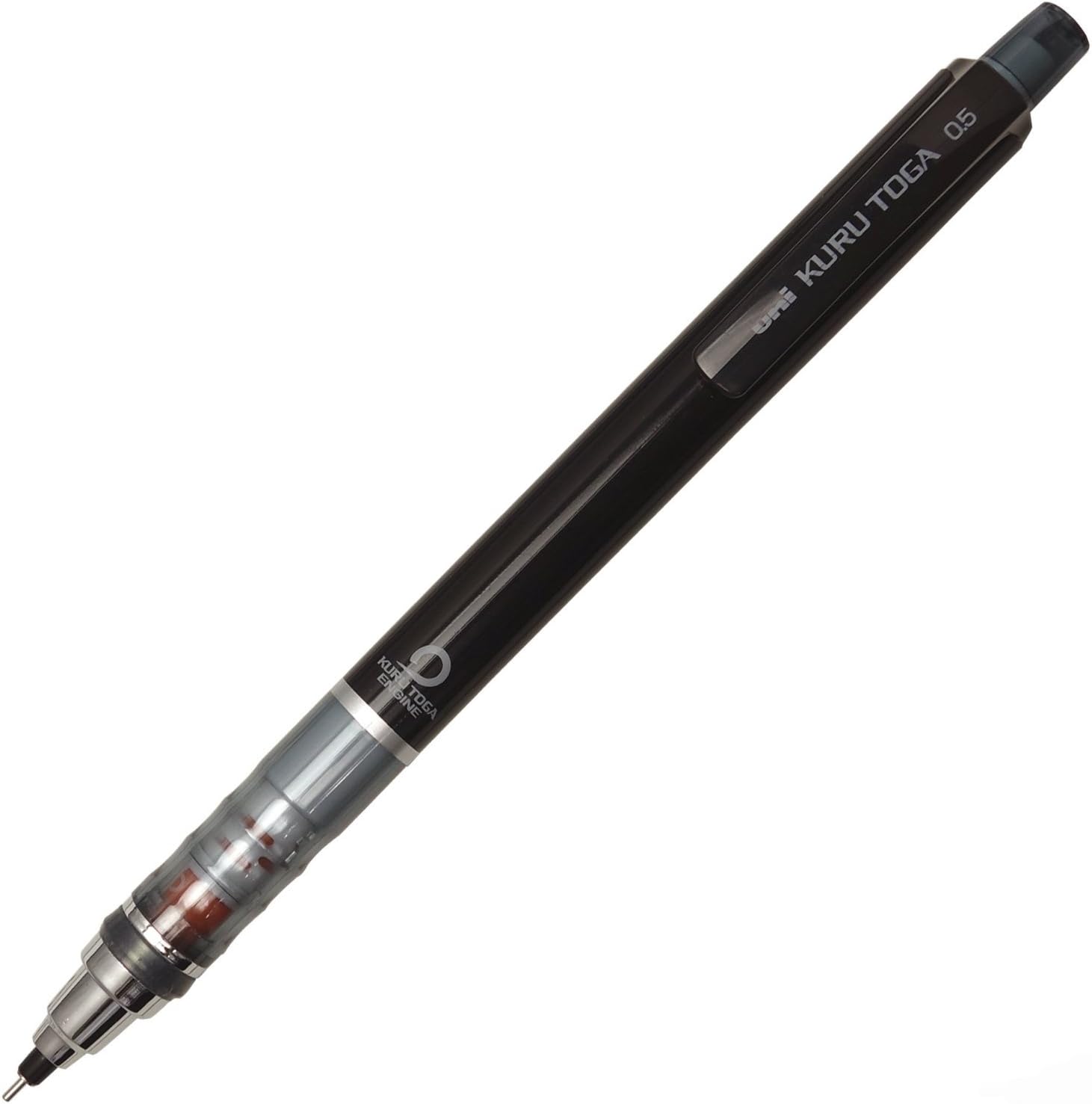
Kuru Toga Standard 0.5 mm
The cheapest way into the rotating engine. A clear housing above the grip shows the orange gear stepping round as you write, which is also the quickest way to prove the mechanism is doing something. One full turn of the lead takes about 40 strokes. No other model comes in as many barrel colors.
Check availability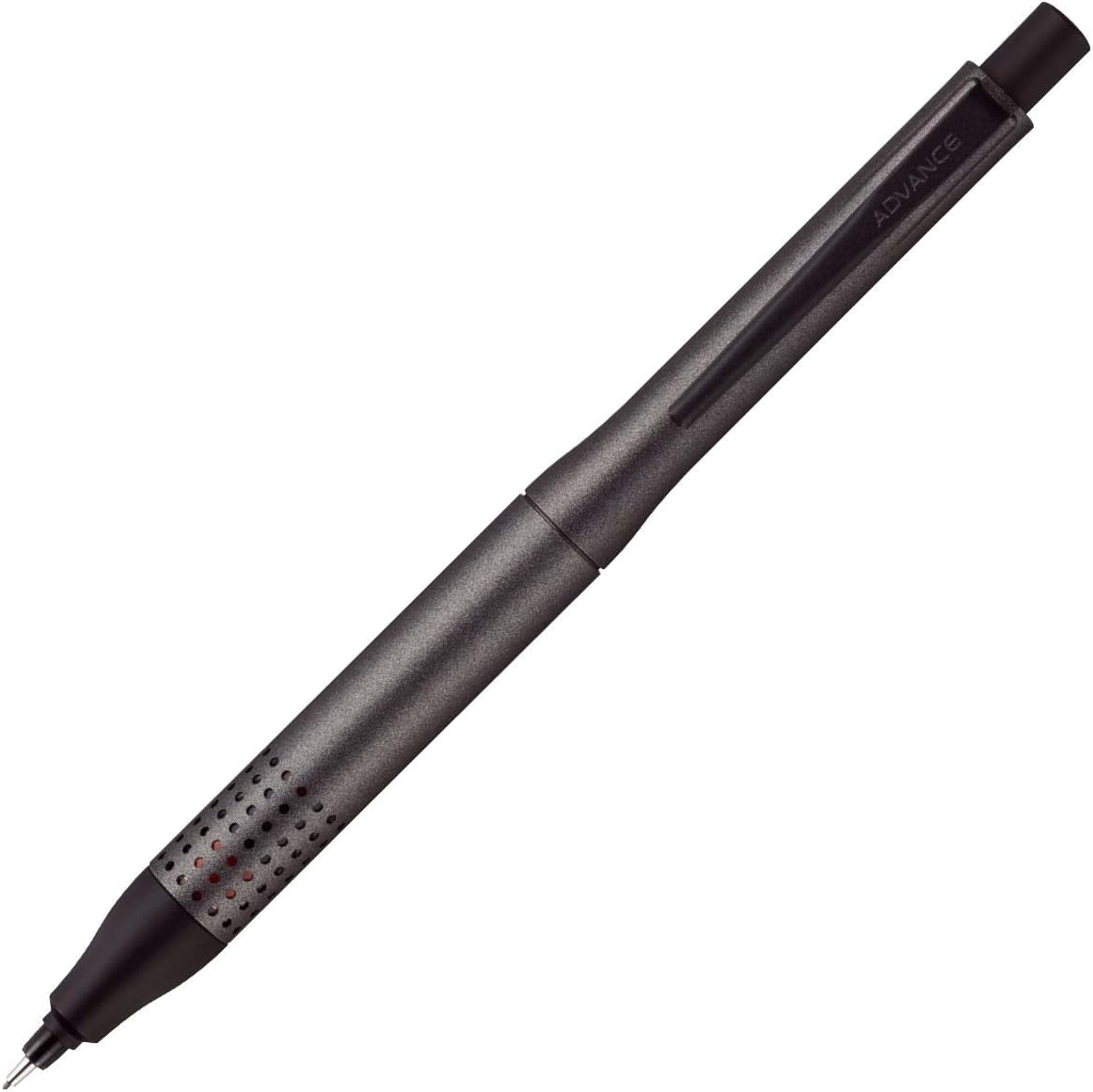
Kuru Toga Advance Upgrade 0.5 mm
Two things separate this from the plastic models. The W Speed Engine turns the lead in roughly 20 strokes rather than 40, and a sliding pipe supports the graphite right down at the paper, retracting as the tip wears. The perforated metal grip also drops the balance point toward your fingers.
Check availability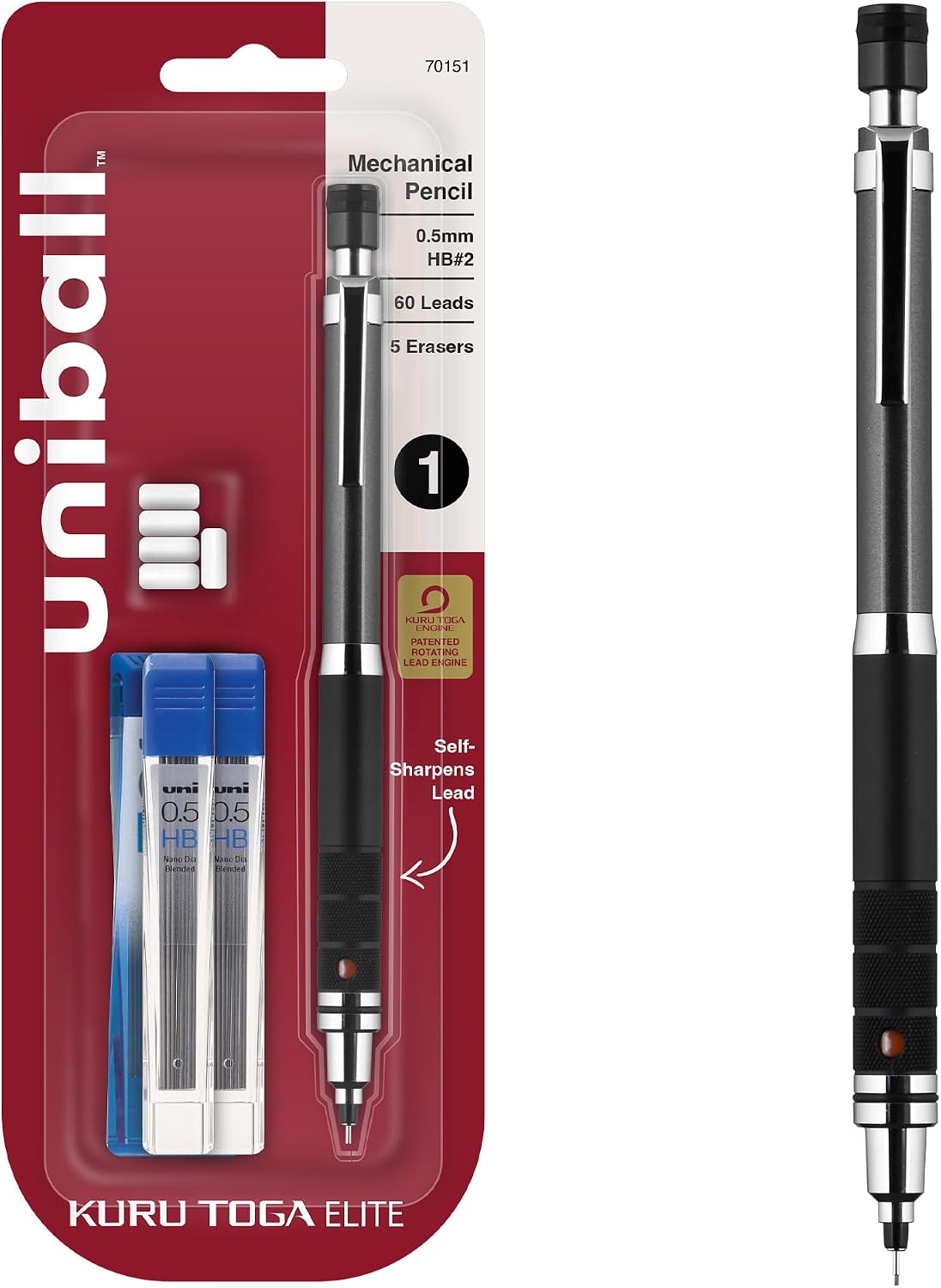
Kuru Toga Elite Kit 0.5 mm
Item 70151. One gun metal pencil, 60 leads in 0.5 mm HB (No. 2) and five spare erasers, which covers a school year without a second purchase. The knurled section runs the length of the grip and holds on better than smooth plastic once hands warm up.
Check availability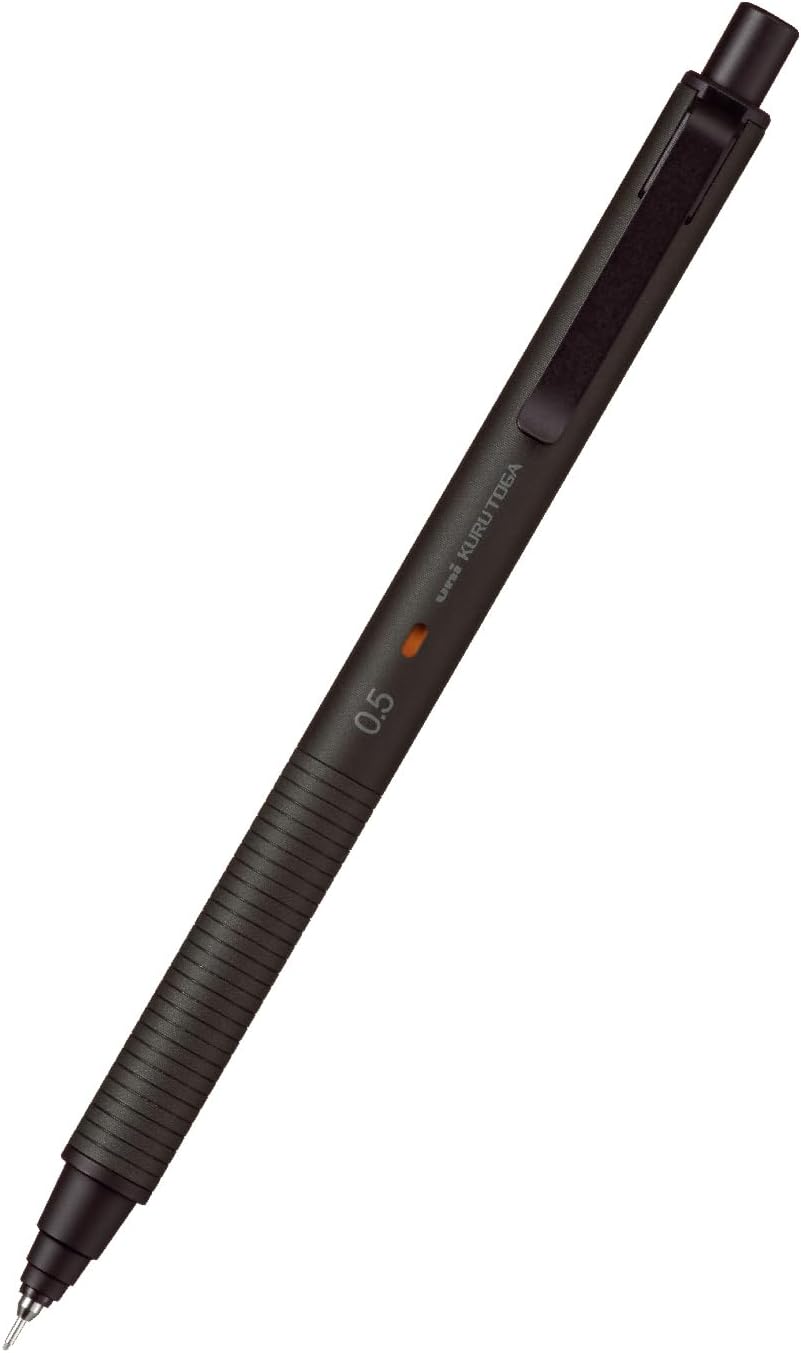
Kuru Toga Metal 0.5 mm
Aluminum body with a Mild Edge grip: a blasted surface cut with fine lines rather than a knurl that bites into your fingers. A resin Nib Damper at the tip absorbs part of the impact each time the lead lands, and the engine inside is the revised one that keeps movement at the point down. It won a Good Design Award in Japan in 2024.
Check availability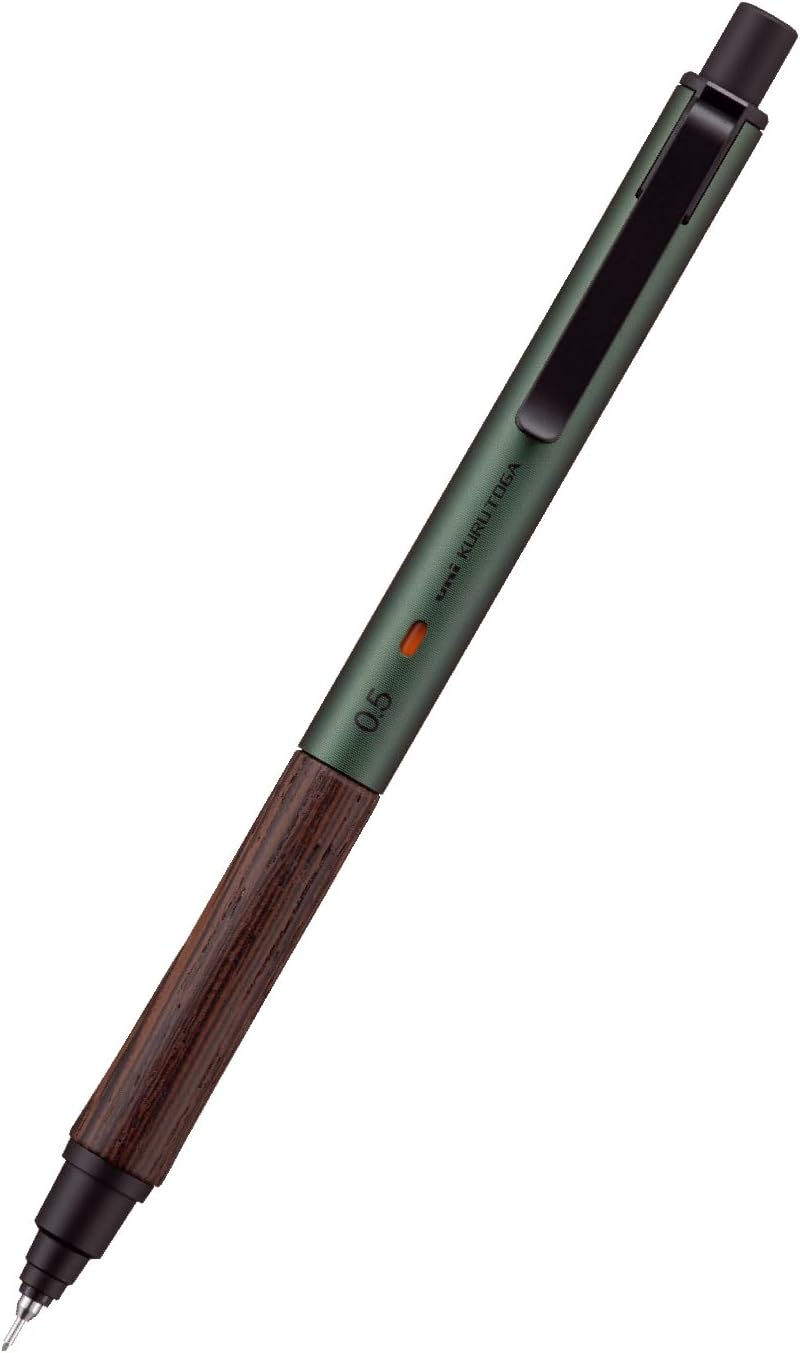
Kuru Toga Wood 0.5 mm
A natural wood grip under an aluminum rear body, released in March 2025 in Forest Green and Steel Gray. Grain and tone differ from pencil to pencil, so the one that arrives will not match the catalog photograph. That is the timber, not a defect, and it is the reason to want this one.
Check availability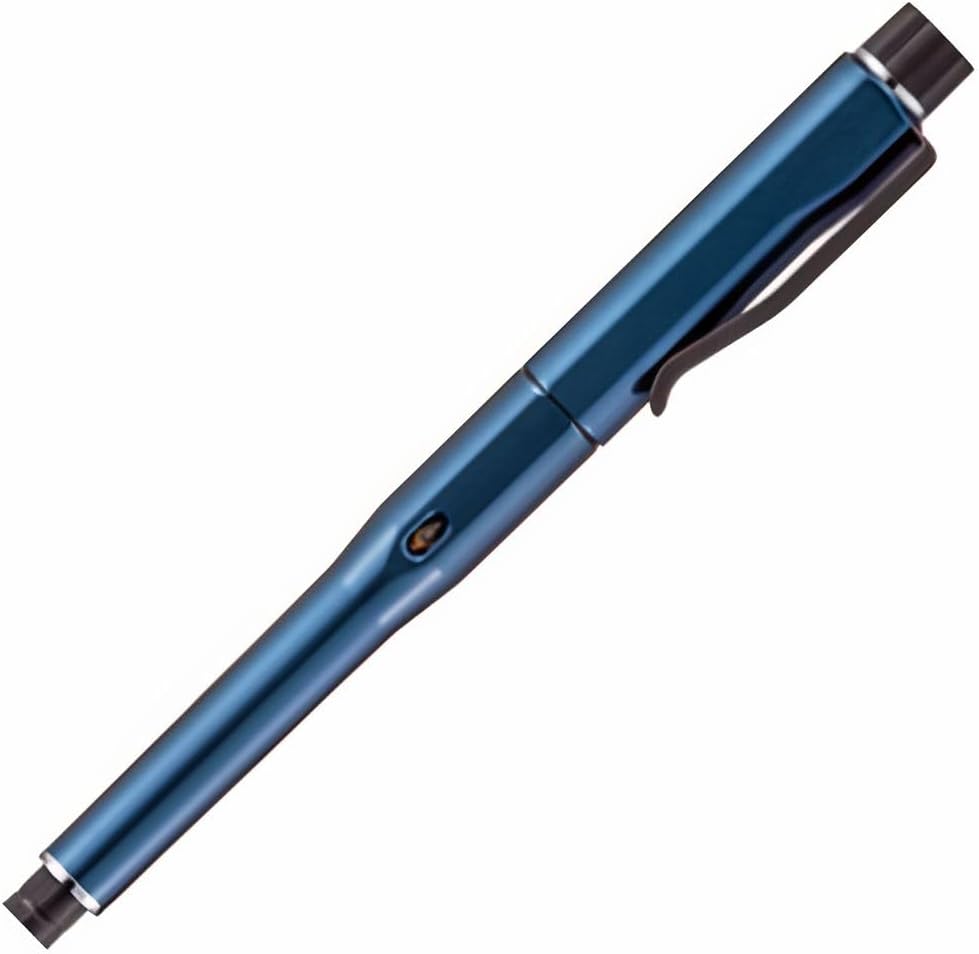
Kuru Toga Dive 0.5 mm
Pull the magnetic cap and the lead is already out, ready to write. From there the pencil feeds fresh graphite by itself as the tip wears down, across five settings you match to lead hardness and how hard you press. Rotation stays at the standard 40-stroke rate, so buy this to stop clicking rather than to rotate faster.
Check availabilityMore bestsellers, colors and multi-packs
Roulette, Silver
Roulette, 3-pack
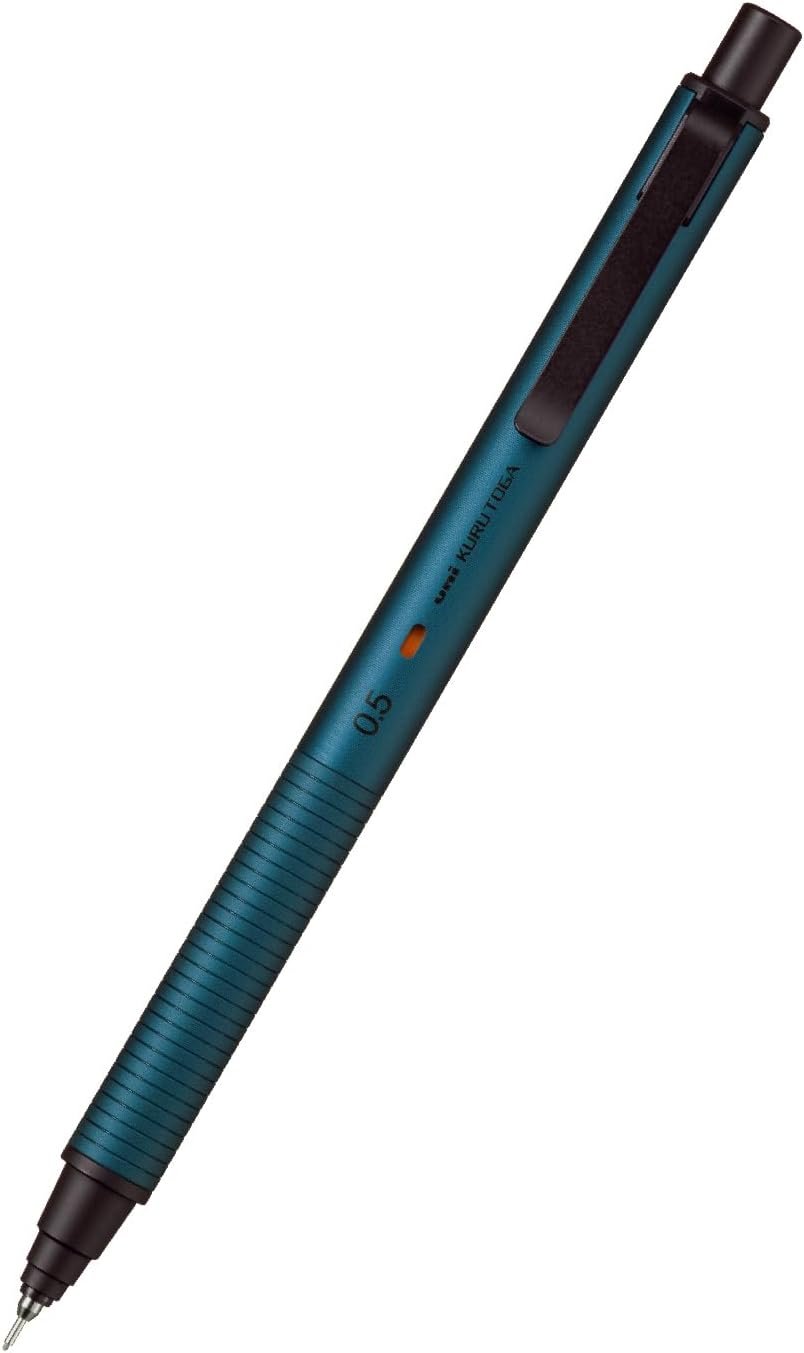
Metal, Silent Blue
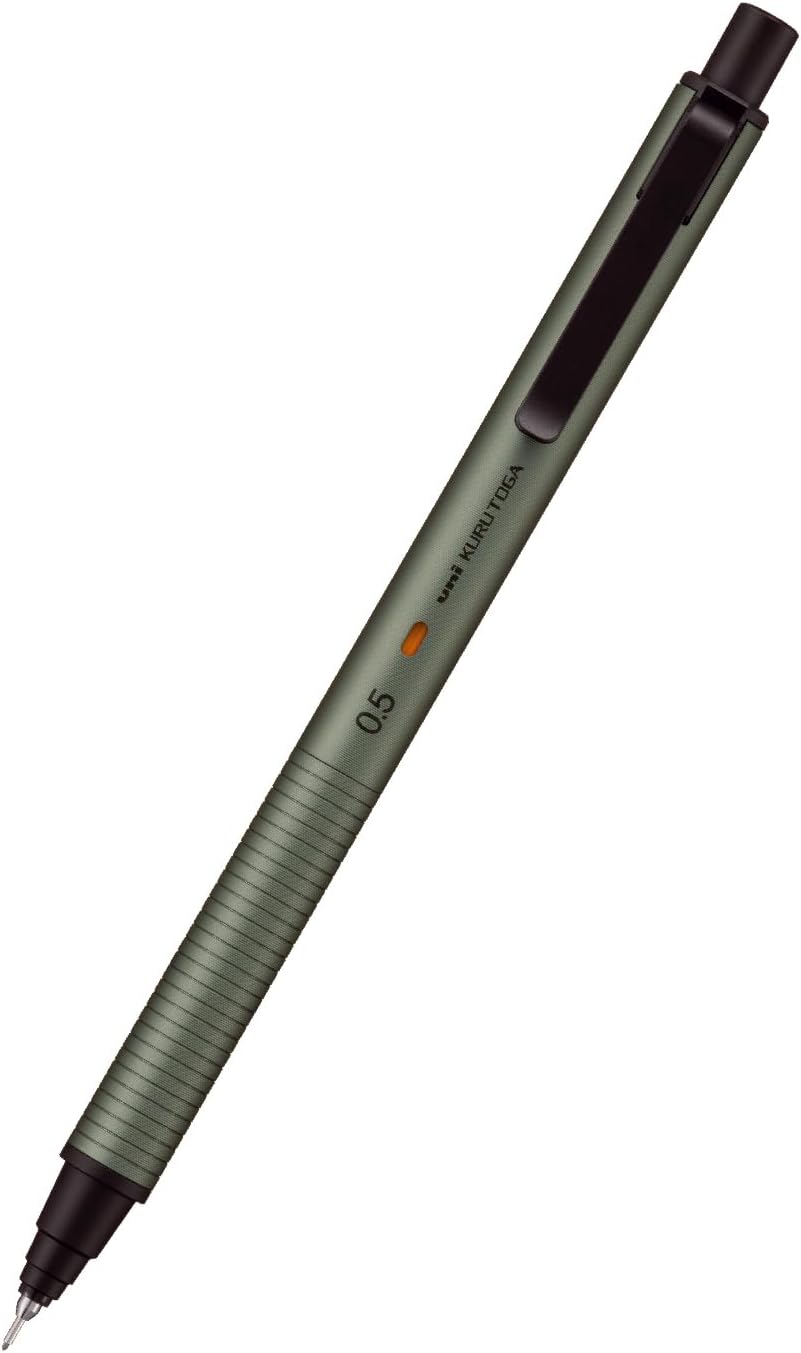
Metal, Phantom Gray
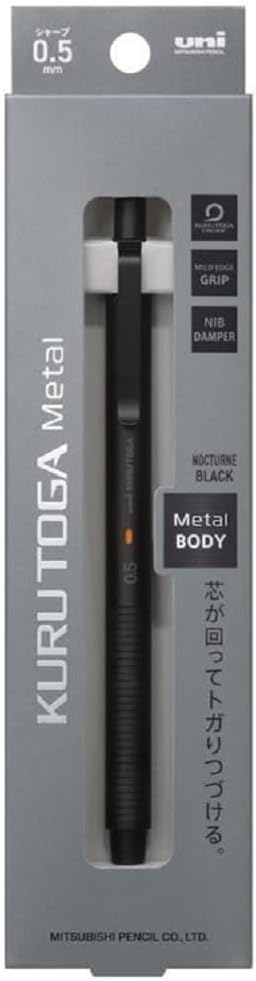
Metal, boxed
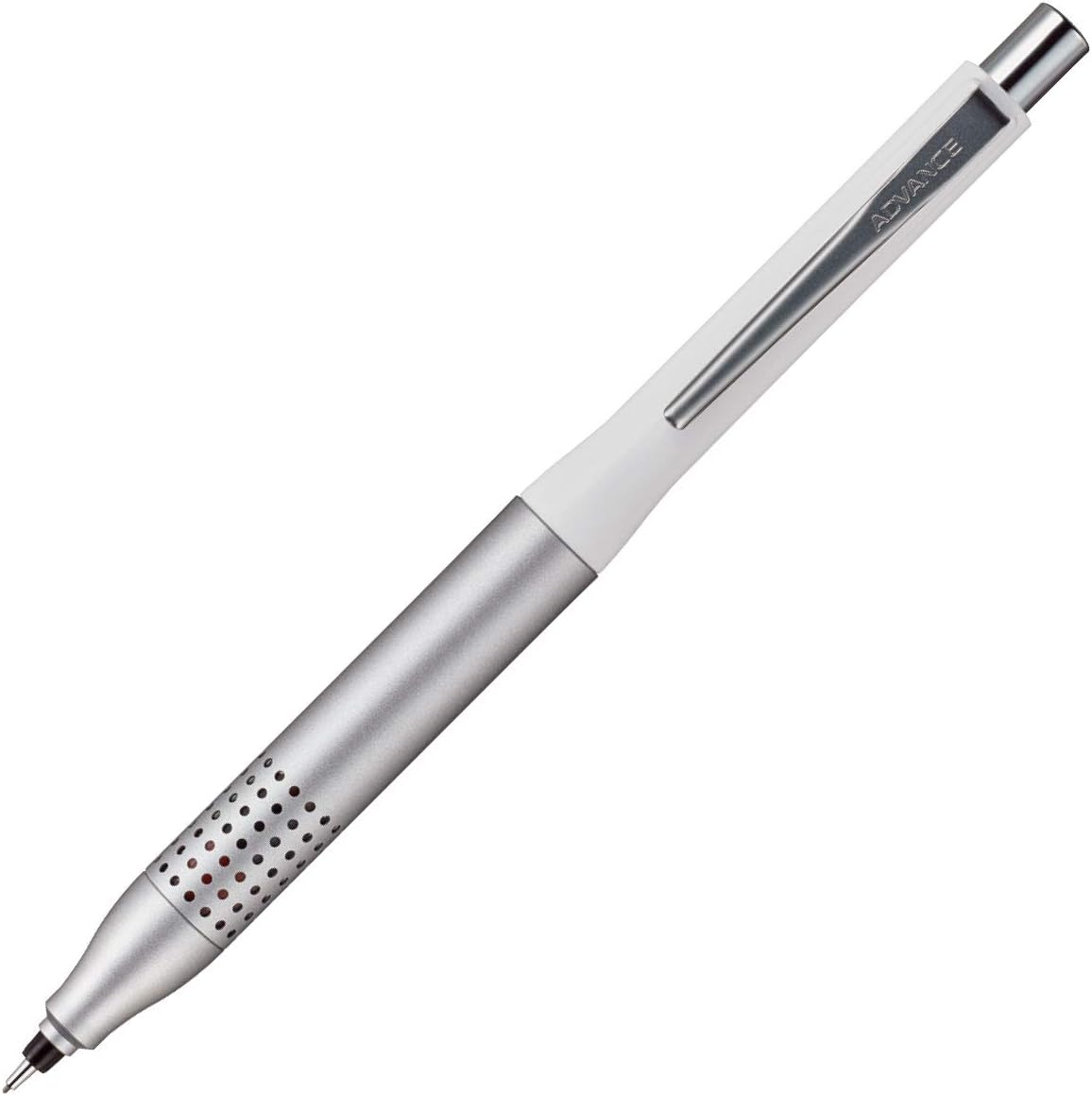
Advance Upgrade, White
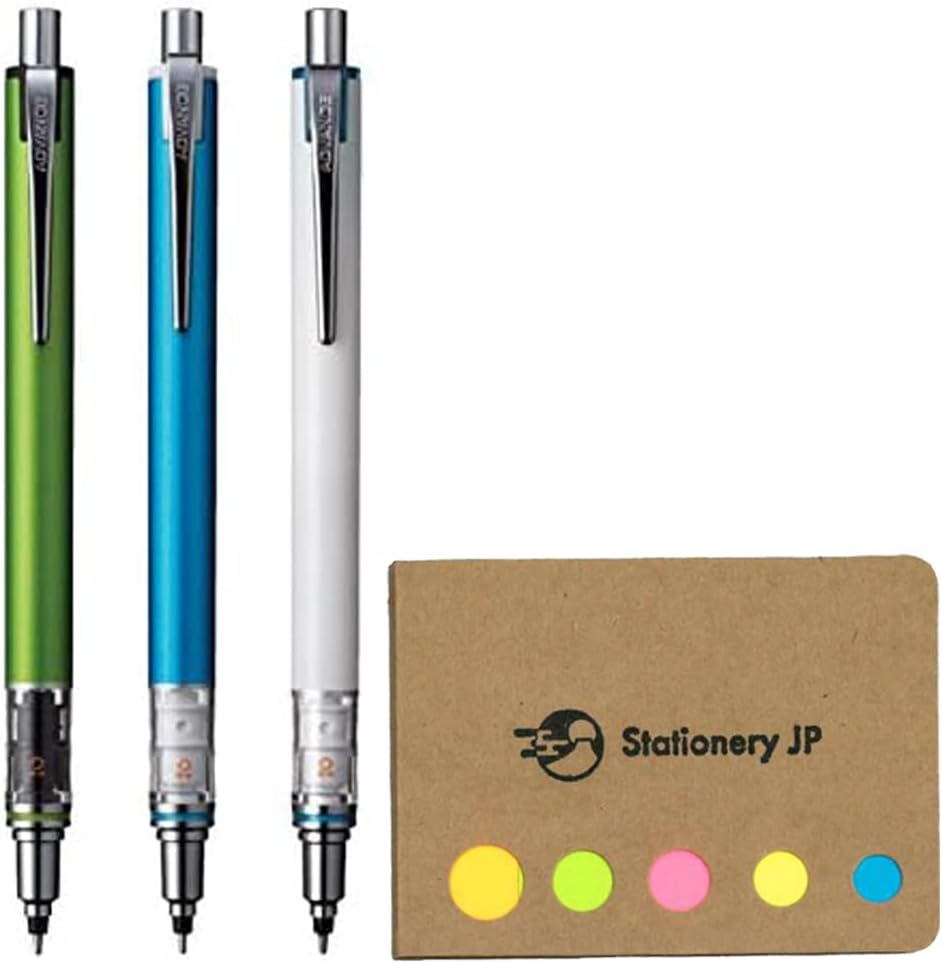
Advance, 3-pack
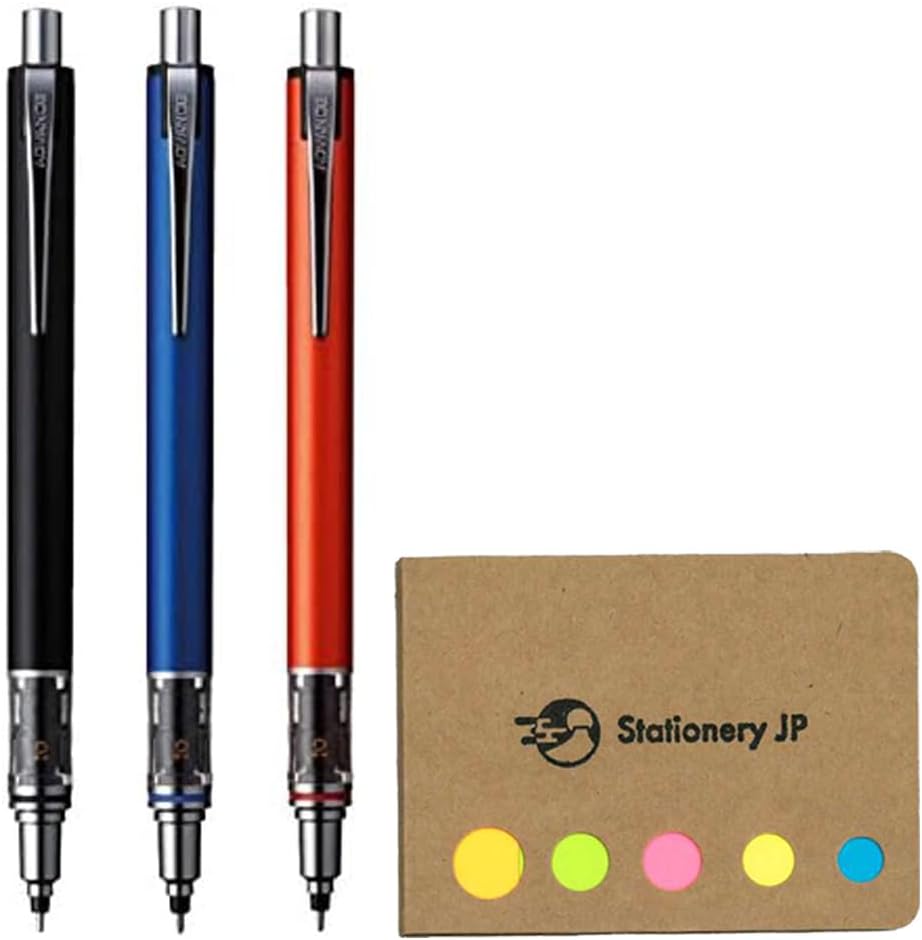
Advance, dark 3-pack
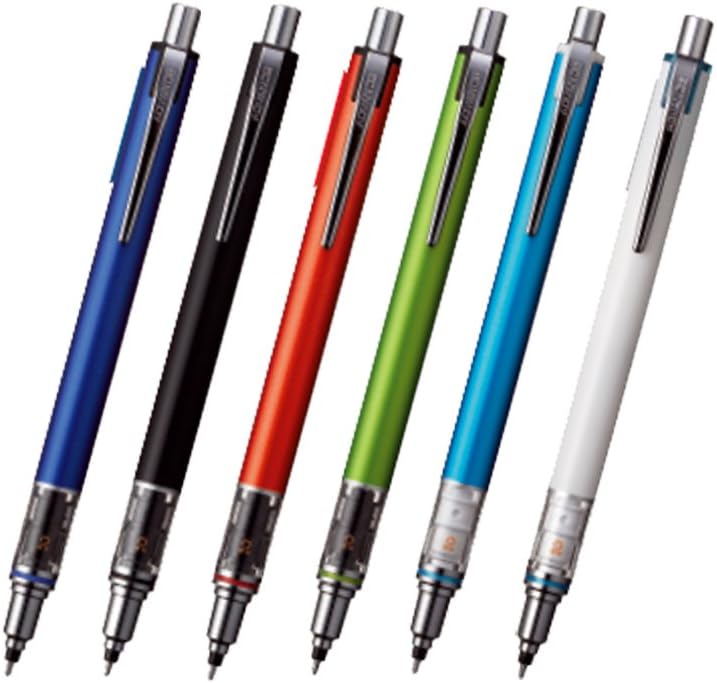
Advance, 6-pack
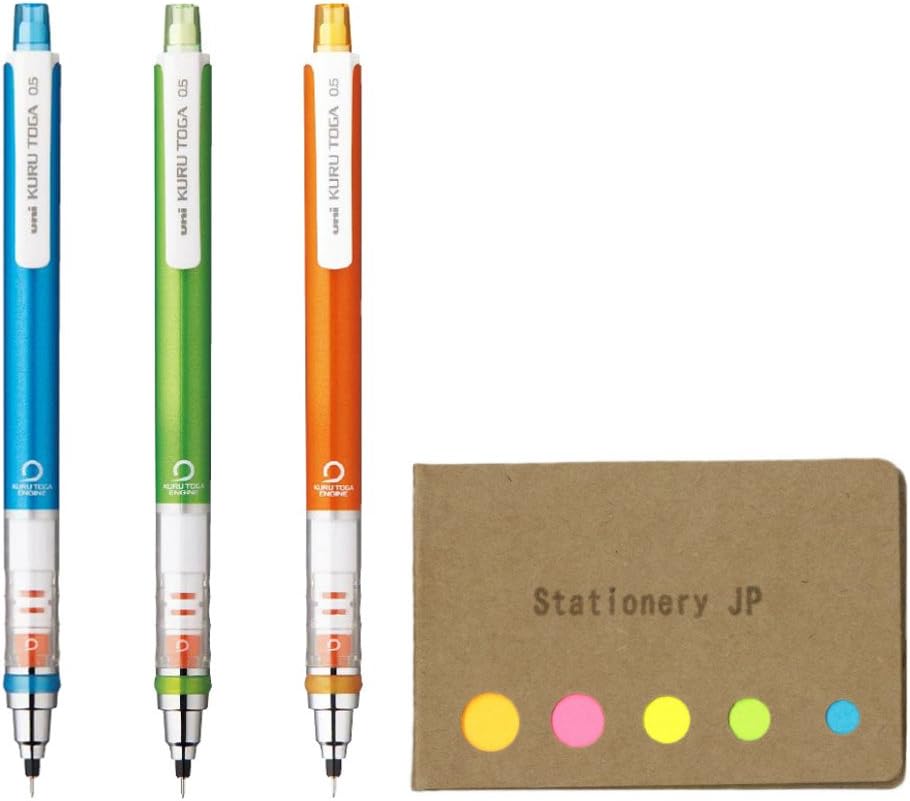
Standard, 3-pack
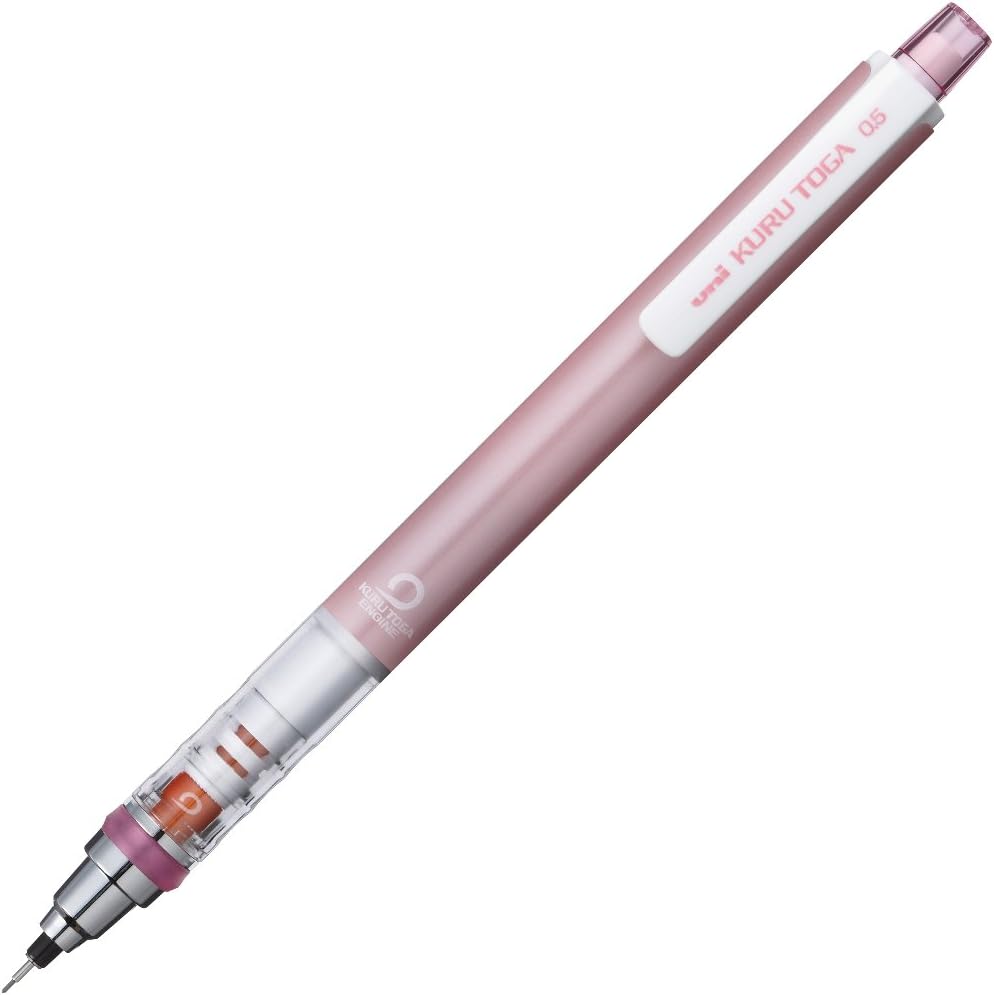
Standard, Baby Pink
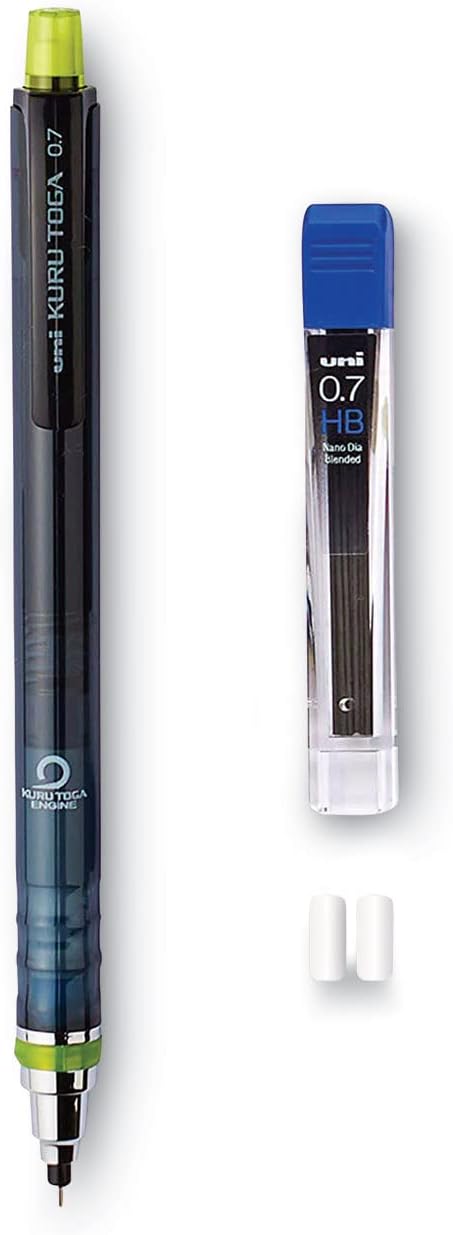
Starter kit, 0.7 mm
These are the ones people actually buy. The full Kuru Toga range runs wider than any page can hold: limited colors, character editions, regional exclusives and seasonal runs appear and disappear, so a finish can be gone even while the model itself is still in production.
Which Kuru Toga Fits How You Write
Notes, homework, math
Short strokes are what the engine feeds on. Printed handwriting, equations and worksheet answers lift the tip off the page constantly, and every lift is one step of rotation.
- Standard 0.5 mm is the cheapest way to find out if you like it
- Elite adds a knurled metal grip and arrives with lead and erasers
- Three-packs and six-packs cut the price per pencil
- The window on a Standard lets you watch the gear step round
Fast writing and English
English is built from fewer, longer strokes than Japanese, so the original 40-stroke rotation gets fewer openings. Halving that count is the whole point of the W Speed Engine.
- Advance and Advance Upgrade turn the lead in about 20 strokes
- The sliding pipe supports soft lead that would otherwise snap
- 2B gains most, because it flattens fastest
- Advance Upgrade puts the weight lower, closer to your fingers
Something you keep
Past a certain price the engine stops being the variable and the body starts. These all run the stabilized mechanism that holds movement at the tip down.
- Metal: aluminum, a Mild Edge grip and a Nib Damper at the point
- Wood: a natural grip that marks and darkens as you use it
- Dive: lead that feeds itself, behind a magnetic cap
- Roulette or Elite for a metal grip without the extra mechanism
Someone filling pages with dense printed notes gets more out of a 0.5 mm Standard than out of a heavier body. Someone writing fast English, or pressing hard enough to snap thin lead, has a real mechanical reason to pay for an Advance.
How the Kuru Toga Engine Works
The point wears round, not flat
Hold any mechanical pencil at a normal writing angle and the graphite grinds away faster on the side touching the paper. Within a paragraph the tip is a wedge, and line width now depends on which face happens to be down. Turning the lead spreads that wear all the way around instead.
Your hand powers it
Pressing the tip into the page loads the mechanism. Lifting it lets the mechanism take one small step round. There is no switch, no motor and nothing to charge, and the pencil works out of the packet with lead already inside.
40 strokes, or 20
The original engine needs roughly 40 of those press-and-lift cycles for one complete turn of the lead. A 20-tooth mechanism in the Advance family gets there in about half that. The gap matters most to handwriting built from long strokes rather than short ones.
It is not sharpening anything
No blade and no abrasive touches the graphite inside the barrel. The engine only governs how the lead wears, which is why results depend on how you write. Unbroken cursive keeps the tip on the page and starves the mechanism of cycles, and broad shading deliberately wants the flat face it is trying to remove.
Every Model Side by Side
| Model | One lead rotation | Body and grip | Lead sizes | Best for |
|---|---|---|---|---|
| Standard | About 40 strokes | Plastic barrel, molded grip | 0.5, 0.7 mm | A first Kuru Toga, school, multi-packs |
| Elite | About 40 strokes | Knurled metal grip section | 0.5 mm | Grip texture, kits with lead and erasers |
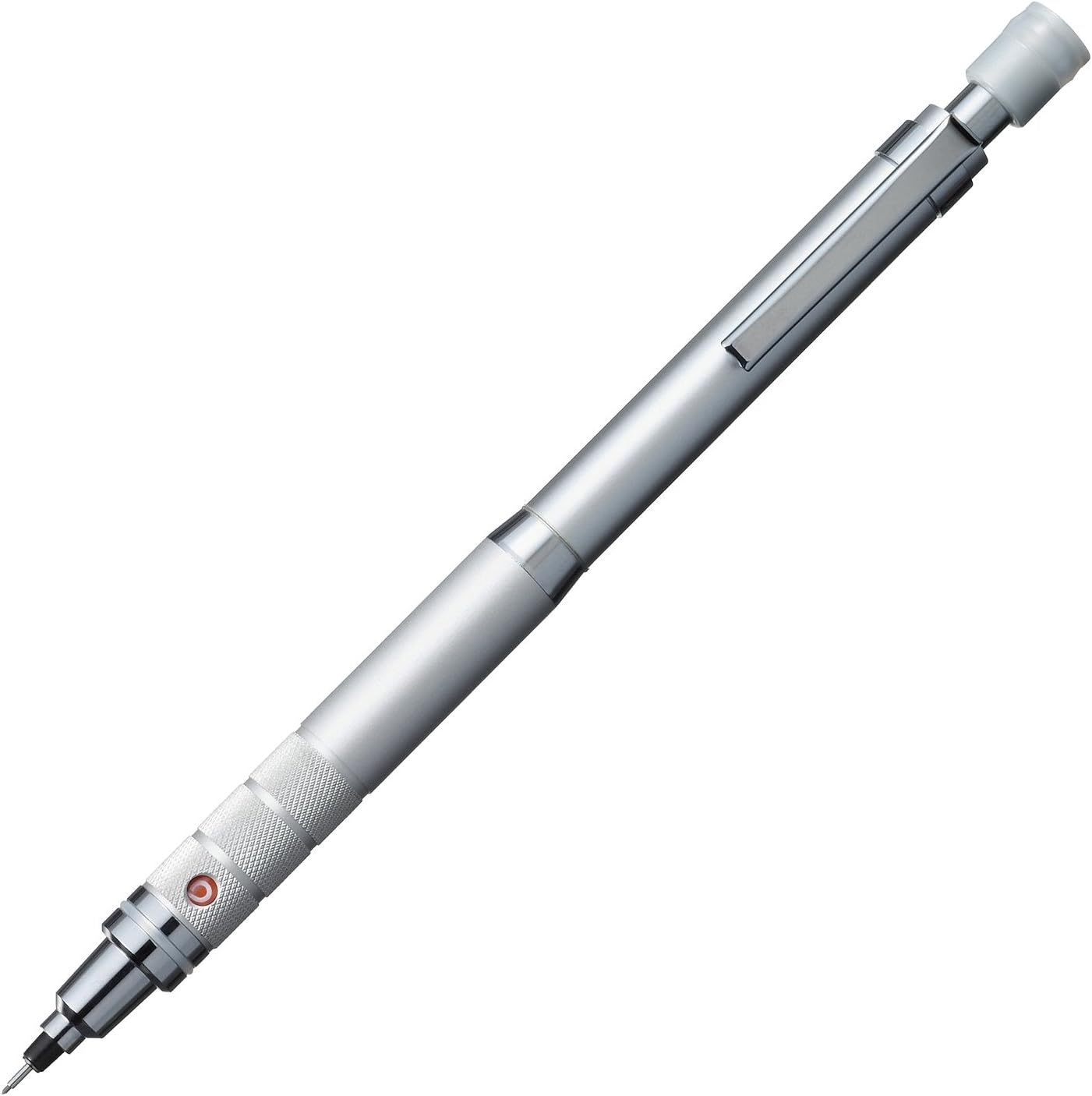
| Roulette | About 40 strokes | Knurled aluminum grip | 0.5 mm | The same idea under its Japanese name |
| Advance | About 20 strokes | Plastic barrel, sliding guide pipe | 0.3, 0.5 mm | Fast English writing, softer lead |
| Advance Upgrade | About 20 strokes | Perforated metal grip, low balance | 0.5 mm | Advance speed with a metal front end |
| KS | About 40 strokes | Plastic, reduced tip movement | 0.3, 0.5 mm | The least noticeable wobble at the point |
| Metal | About 40 strokes | Aluminum, Mild Edge grip, Nib Damper | 0.3, 0.5 mm | Weight and a settled writing feel |
| Wood | About 40 strokes | Natural wood grip, aluminum body | 0.5 mm | A grip that changes with use |
| Dive | About 40 strokes | Faceted body, magnetic cap | 0.5 mm | Automatic lead feed, far fewer clicks |
| Alpha Gel Switch | Switchable | Cushioned gel grip | 0.5 mm | Turning rotation off for controlled line work |
| LAMY safari KURUTOGA inside | About 40 strokes | safari grip, large metal clip | 0.5 mm | The KS engine inside a LAMY body |
- Model codes identify the mechanism far more reliably than a seller title does. M5-559 is the Advance, M5-1017 the Roulette, M5-KH the Metal and M5-5000 the Dive. uniball kits sold in the United States use item numbers instead, such as 70151 and 70137 for the Elite.
- Elite and Roulette are close relatives, both built on the original engine with a knurled metal gripping section. North American stock from uniball tends to carry the Elite name. Japanese-market pencils carry Roulette.
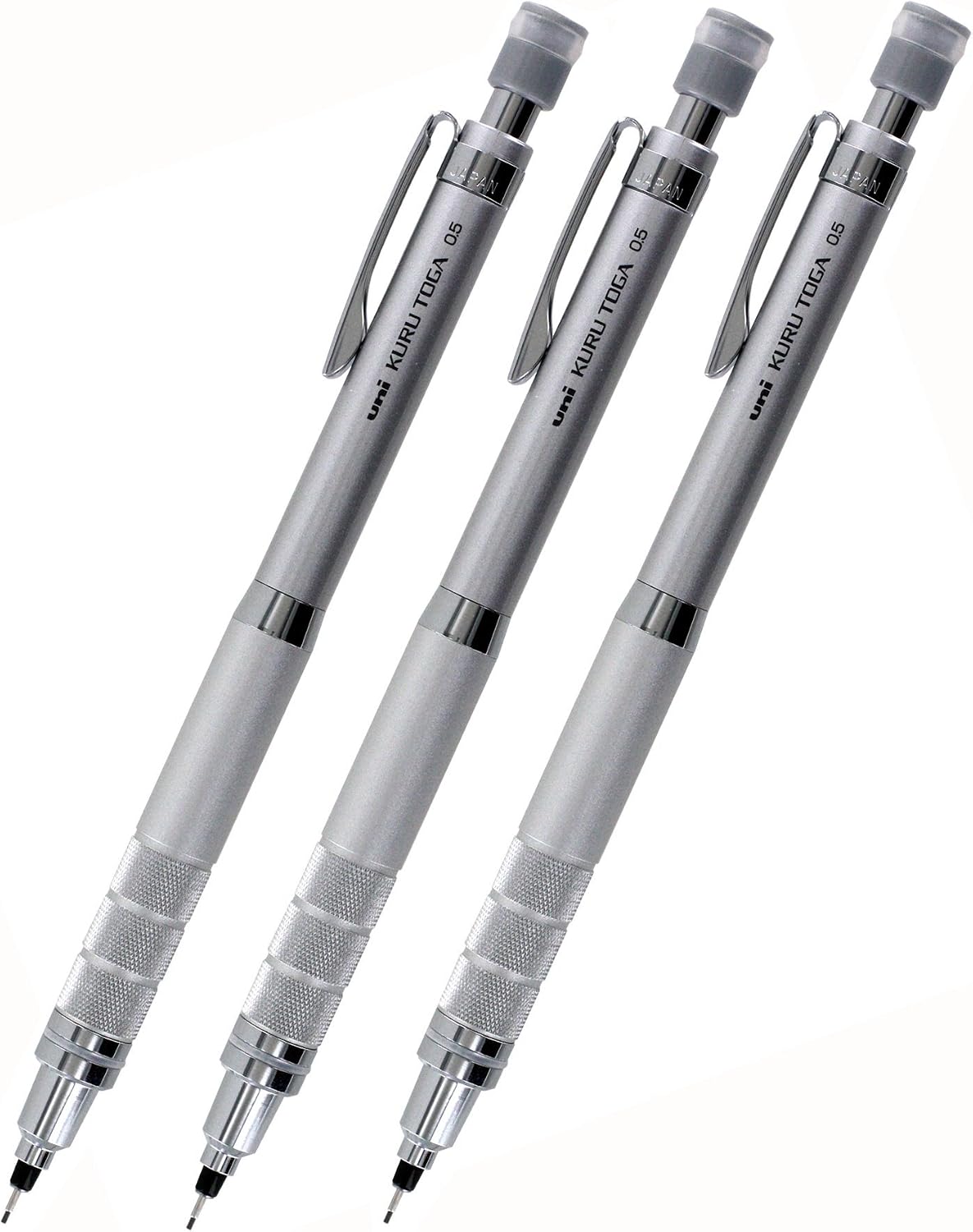
- A three-pencil set is not a different pencil from the single. Multi-packs, sticky-note bundles and starter kits change what comes in the package and leave the mechanism alone, so read lead diameter, lead count and eraser count line by line rather than guessing from a barrel color.
- Rotation speed is the only difference on this table that changes how the pencil writes. Everything else changes how it feels in the hand, which matters, just not in the same way.
0.3, 0.5 or 0.7 mm
0.3 mm
Finest line, least forgiving
- Line
- Narrowest in the range
- Suits
- Formulas, margin notes, dense planners
- Breakage
- Least tolerant of side pressure
- Found on
- Advance, KS, Metal in Nocturne Black
A 0.3 mm point fits more writing into the same space and holds detail that 0.5 mm loses. There is also less graphite across the lead, so a heavy hand or an over-long section of exposed tip snaps it. Rotation keeps the shape of the point even; it cannot add material that was never there.
0.5 mm
The default, and the widest choice
- Line
- Fine without being fragile
- Suits
- Almost everything
- Breakage
- Forgiving of normal pressure
- Found on
- Every model family in the range
Start here unless something specific pushes you elsewhere. Every family in the range comes in 0.5 mm, which means the widest choice of bodies, grips, colors and kits by a long way. It writes fine enough for small handwriting without demanding the light touch that 0.3 mm does.
0.7 mm
Broadest line, hardest to break
- Line
- Widest in the range
- Suits
- Larger handwriting, heavy pressure
- Breakage
- Most tolerant of all three
- Found on
- Standard, uniball starter kits
Thicker graphite survives pressure that snaps 0.5 mm, which is the entire reason to pick it. The trade is line width. Even wear will not make a 0.7 mm point behave like a 0.3 mm one, so choose this for durability rather than for fineness.
- Diameter decides the size of the mark. Hardness decides how dark it comes out and how fast it disappears. HB, which US packaging labels No. 2, is the general-purpose grade and what most kits ship with.
- Softer B and 2B leads lay down a darker mark and wear away faster. Harder grades stay lighter and last longer. Rotation earns its keep most at the soft end, because that is where a flat edge forms within a few lines.
- Never load 0.7 mm lead into a 0.5 mm pencil, or 0.5 mm into a 0.3 mm mechanism. It jams the clutch, and clearing it means stripping the feed path.
- Several kits include uni NanoDia lead, which blends fine diamond particles into the graphite. Any lead of the correct diameter works in the pencil, and matching uni refills are what the instructions call for.
Reviews and Owner Photos
Oh boy. Been using cheapo Papermates that last a couple of months and then just stop working. This Kuru Toga though? Oh man, I don't know where to begin. Form factor is great! Incredibly comfortable and wothba nice heft. Material quality is top notch as well. It just "feels good" in the hand. Writes like a dream! I use the .5 leads and with THIS thing they just Do. Not. Break. Feeds perfectly on each click as well. Just a wonderfully made product that'll likely last forever and it's ridiculously UNDER priced for how good a product it is. Get it.
Jack R.
I got this pencil because I wanted something nicer than a basic mechanical pencil for notes, homework, and everyday writing. The silver finish looks clean, and it has a more premium feel without being too flashy. The 0.5mm lead size is a good balance for writing neatly while still feeling smooth on the page. I like that the pencil feels controlled in the hand, especially when writing for a while or doing math problems where neat lines matter. The kit is also nice because it feels ready to use instead of just being a single pencil tossed in a package. It is a small thing, but good pencils make studying or note taking feel a little less annoying. Overall, I’m happy with it. It writes cleanly, feels comfortable, and is a nice upgrade from cheaper mechanical pencils.
Christian
Really impressed with the quality of this pencil. The silver body looks nice and it has a grip, it's built super well, and feels very durable. It's also really lightweight and portable, The lead quality is amazing, it doesn't break easily and writes cleanly m probably because its diamond lead. It's really cool to look through the tiny window and watch the core rotate as you use it. You can actually see this mechanism in action if you stick a paper on the tip and you can literally see it spinning.
Radhika
I've used many mechanical pencils over the years, and the Uni Kuru Toga Metal quickly became one of my favorites. The all-metal body feels solid and premium in hand, with a comfortable weight that makes writing feel more controlled and precise. The automatic lead rotation mechanism is the standout feature. It keeps the lead tip consistently sharp as I write, producing cleaner lines and more uniform handwriting compared to standard mechanical pencils. I especially notice the difference during long note-taking sessions, where the writing remains crisp without the lead developing a flat edge. The 0.5mm fine point is perfect for detailed writing, and the pencil feels well-balanced without being too heavy. The Nocturne Black finish gives it a sleek, professional appearance that looks great on any desk. Overall, this is an excellent mechanical pencil that combines thoughtful engineering, durability, and a premium design. It's a great choice for students, professionals, and anyone who appreciates high-quality writing instruments.
Justin Ching
My journey had started in search of a gift for my best friend. After much deliberation, I had made the decision to purchase this pencil. My reason for this is because he loves to write, so after being very satisfied with my previous purchase of an Alpha-Gel variant of this pencil mechanism, I chose to purchase this model for its higher quality. Thus far, he has been very satisfied, running through numerous packs of graphite noting that it feels great in the hand, and writes with consistency. With his model life, it has also survived numerous incidents, likely in part to its metal construction. Highly recommended!
Alyxan Elin Hughes
Great Pencil! A student had one and I loved how it wrote so I purchased this one. It writes very smooth and the lead is the perfect shade. It is easy to carry around and the rotating lead makes it easier to get consistent letters!
Amber
Loading, Refilling and Keeping It Alive
- 1
Load lead that matches the barrel
Pull the cap off the back, lift the eraser out if it sits over the reservoir, and drop in a few pieces of the right diameter. A 0.5 mm pencil takes 0.5 mm lead and nothing else. Cramming the reservoir full does not stretch the refill interval, and it makes a jam much harder to trace later.
- 2
Click out a short length, then just write
One or two clicks is plenty. Rotation happens inside the barrel, so there is nothing to do with your fingers between words. Rolling the pencil by hand, the habit an ordinary mechanical pencil trains into you, now works against the mechanism rather than with it.
- 3
Resist the urge to extend more lead
A long section of exposed graphite acts as a lever and snaps under pressure that a short one shrugs off. This bites hardest at 0.3 mm. Advance models write happily with almost nothing showing past the sliding pipe, because the pipe holds the lead steady down at the paper.
- 4
Swap the eraser when it runs out
Type-S replacements fit the Elite, Metal, Dive and the LAMY safari KURUTOGA inside. Check yours before buying a pack, since the safari version takes uni Eraser S rather than the eraser made for the ordinary safari pencil. That small eraser handles single corrections. Redoing a paragraph is a job for a block.
- 5
If the lead stops feeding, stop clicking
Hammering the knock button drives a broken fragment deeper into the clutch. Tip the loose refill lead out of the back first, then look down the guide pipe with the tip pointed at a light. Almost every dead Kuru Toga turns out to be a jam rather than a failed engine.
- 6
Treat the tip as the fragile part
Retract the guide pipe on models that allow it before the pencil goes loose into a bag, and keep it off hard floors point-first. The engine needs no oil and no adjustment. Taking one apart creates alignment problems considerably worse than the jam you were chasing.
Wood grips arrive with their own grain and color. Two pencils out of the same carton will not match each other, and neither will match the listing photo.
The engine counts pressure cycles, so writing style changes what you see. A page of printed notes rotates the lead steadily. A page of unbroken cursive gives it far fewer openings, and a long shading pass gives it almost none.
Watch the window on a Standard for a minute if you want proof the thing is running. The orange gear steps round in small increments, one nudge per stroke, and after roughly 40 of them the lead has turned a full circle.
About Kuru Toga
Mitsubishi Pencil has made writing instruments since 1887 and put the uni name on a pencil in 1958. Kuru Toga came much later, in March 2008, out of a question nobody had bothered asking: why does a mechanical pencil accept that its point turns into a wedge within a paragraph?
The first model answered with a gear train driven by writing pressure. Every release since has kept that engine and changed what sits around it. Advance doubled the rotation speed and added a sliding pipe to protect the graphite. On the Advance Upgrade the balance point drops into a metal front section. The KS generation went after the tip movement the mechanism itself creates, and Metal wrapped the whole thing in aluminum with a Mild Edge grip and a Nib Damper. Then came a natural wood grip in 2025 and, on the Dive, lead that feeds itself.
More than 100 million Kuru Toga pencils have sold since launch. In March 2026 the engine crossed into another company’s product for the first time, as LAMY safari KURUTOGA inside, which fits the KS mechanism into the shaped safari grip in Black, Vista, Blue and Yellow.
Listings write the name both ways. North American uniball packaging says Kuru Toga, plenty of imported Japanese stock says Kurutoga, and the box itself says クルトガ. They are the same pencil. Model codes are what actually separate one mechanism from another, which is why a seller title on its own is a poor way to buy a specific one.
Frequently Asked Questions
Kuru Toga is a mechanical pencil series developed by Mitsubishi Pencil Co., Ltd., the Japanese company behind the uni brand. Its defining feature is the Kuru Toga Engine, an internal mechanism that rotates the graphite lead in small increments as the pencil is used. This helps the lead wear more evenly instead of developing the broad, angled edge common with standard mechanical pencils.
Kuru Toga is made by Mitsubishi Pencil Co., Ltd., a Japanese writing-instrument manufacturer founded in 1887. The company introduced the uni brand in 1958 and launched the first Kuru Toga mechanical pencil in 2008. Kuru Toga has since expanded into Standard, Advance, Elite, KS, Metal, Wood, Dive, and other model families.
Writing pressure activates the internal mechanism. As the lead repeatedly touches and leaves the paper, the engine turns it slightly, gradually rotating the graphite around its axis. The original Kuru Toga mechanism completes a full rotation over roughly 40 pressure cycles. The W Speed Engine used in Advance models gets there in about half that. The pencil does not physically sharpen the graphite. It controls how the tip wears.
Kuru Toga Standard uses the original rotating engine. Advance uses the faster W Speed Engine, which cuts one full lead rotation from about 40 writing strokes down to roughly 20. Advance also uses a sliding guide pipe that supports the graphite close to the paper and retracts as the lead wears. This can reduce breakage and allows more writing with less exposed lead.
Elite and Roulette are closely related Kuru Toga models built around the original rotating mechanism and a textured metal gripping section. Names and configurations vary between markets. Elite is the name uni uses on versions sold in North America. Roulette turns up most often among Japanese-market models. Both provide more weight and grip texture near the pencil tip than the basic Kuru Toga Standard.
Kuru Toga Metal uses an aluminum body, a refined Mild Edge grip, and an improved mechanism designed to reduce noticeable movement at the tip. A resin Nib Damper helps absorb some of the impact when the pencil touches the paper. Metal is aimed at users who want the Kuru Toga rotation system in a more substantial body with a more stable writing feel.
Kuru Toga Dive combines automatic lead rotation with automatic lead advancement. After writing begins, the pencil can continue feeding graphite as the exposed lead wears down, reducing the need to click the rear button repeatedly. The automatic feed can be adjusted through several settings to suit different lead hardnesses and writing pressure. Dive also uses a magnetic cap and 0.5 mm lead.
Kuru Toga Wood combines a natural wooden grip with a metal body and a modern stabilized Kuru Toga mechanism. The wood grain and tone vary naturally between individual pencils, so two Wood models may not look exactly alike. The model was introduced in Japan in 2025 and originally appeared in Forest Green and Steel Gray.
A 0.5 mm Kuru Toga Standard is the simplest starting point for general notes, schoolwork, calculations, and office writing. Advance makes more sense for users who want faster lead rotation or frequently write English and other Latin-alphabet text. KS provides a more stable tip feel. Metal and Wood add more substantial materials. Dive is better suited to someone who specifically wants automatic lead advancement rather than only the rotating mechanism.
Yes, although the mechanism responds differently depending on writing style. Printed English, equations, annotations, and note-taking create frequent pressure changes that allow the lead to rotate normally. Continuous cursive creates fewer separate pressure cycles, so the mechanism may rotate more slowly. Kuru Toga Advance can be especially useful for Latin-alphabet writing because its W Speed Engine rotates the lead about twice as quickly as the original mechanism.
Kuru Toga works well for detailed sketches, diagrams, technical notation, and other work where a consistently narrow graphite point is useful. It is less advantageous for broad shading techniques that intentionally use the flat side of the graphite. Long uninterrupted drawing strokes also create fewer pressure cycles, giving the rotating mechanism fewer opportunities to turn the lead.
Choose 0.3 mm for very fine handwriting, formulas, compact notes, and detailed line work. It creates the narrowest marks but requires a lighter touch because thin graphite breaks more easily. A 0.5 mm Kuru Toga offers the broadest model selection and balances line width with durability, making it the most versatile size. Choose 0.7 mm for larger handwriting or heavier writing pressure. The thicker graphite resists breakage better but produces broader lines.
Kuru Toga pencils use standard mechanical-pencil graphite matching the diameter specified for the model. A 0.5 mm pencil requires 0.5 mm lead, a 0.3 mm model requires 0.3 mm lead, and the same rule applies to 0.7 mm versions. HB or No. 2 lead is the common general-purpose choice. Softer B and 2B leads create darker marks and wear faster. Harder grades produce lighter lines and generally wear more slowly.
Yes. Kuru Toga mechanical pencils are designed to be refilled rather than discarded when the graphite runs out. Most models load replacement lead through the rear of the pencil after removing the cap and, where necessary, the eraser. Many models also use replaceable erasers. Compatibility varies, so replacement erasers and lead diameter should be matched to the specific model.
Mitsubishi Pencil launched the first Kuru Toga in Japan in March 2008. The original model introduced the rotating-lead concept that still defines the series. Later generations added faster rotation, sliding guide pipes, reduced tip movement, metal and wooden bodies, automatic lead advancement, and collaborations with other writing-instrument brands. More than 100 million Kuru Toga pencils have been sold since the series was introduced.
Pick the Mechanism First
Two questions settle most orders. How fast do you write, and how much pencil do you want in your hand? Lead diameter follows from your handwriting, and the color comes last.
Shop Kuru Toga